
Arm Makes Chips!
Is Arm getting its hands on its customers' business?

Please note that the following is not investment advice. This post may be too long for your email client so please read in your browser by clicking on the title.
‘We’ll make chips over my dead body.’
Robin Saxby, ARM Founding CEO
It’s one of the things that Arm is most famous for: it’s a chip company that doesn’t make chips. A stance that has been a key part of Arm’s strategy since it was articulated by Robin Saxby in 1991 and that has remained in place for more than three decades.
Of course, many companies now leave the actual making of chips these days to foundries like TSMC, an approach that Arm helped to pioneer; what Saxby really implied, and what has made Arm distinctive, is that Arm wouldn’t sell chips to end customers.
The rationale is explained in the Arm history Culture Won:
Robin felt that the only way to satisfy all their ambitions was to make the ARM processor a global RISC standard by collaborating with semiconductor companies in all the major chip markets worldwide. The key rule was to not compete with your customers or, as Robin is widely quoted as saying for many years: “make chips over my dead body.” The chosen way forward was partnership – to create long-term business relationships with silicon manufacturers and end-users for mutual benefit. (my highlighting)
Saxby himself mentions his famous quote in his interview with Charbax from 2017
But then, on 24 March, that all changed when Arm announced its new Arm AGI CPU.
Today, Arm is announcing the Arm AGI CPU, a new class of production-ready silicon built on the Arm Neoverse platform and designed to power the next generation of AI infrastructure.
For the first time in our more than 35-year history, Arm is delivering its own silicon products – extending the Arm Neoverse platform beyond IP and Arm Compute Subsystems (CSS) to give customers greater choice in how they deploy Arm compute – from building custom silicon to integrating platform-level solutions or deploying Arm-designed processors.
Arm even had a Steve Jobs / Jensen Huang like keynote to announce (the) AGI.
… and released a ‘behind the scenes making of’ video:
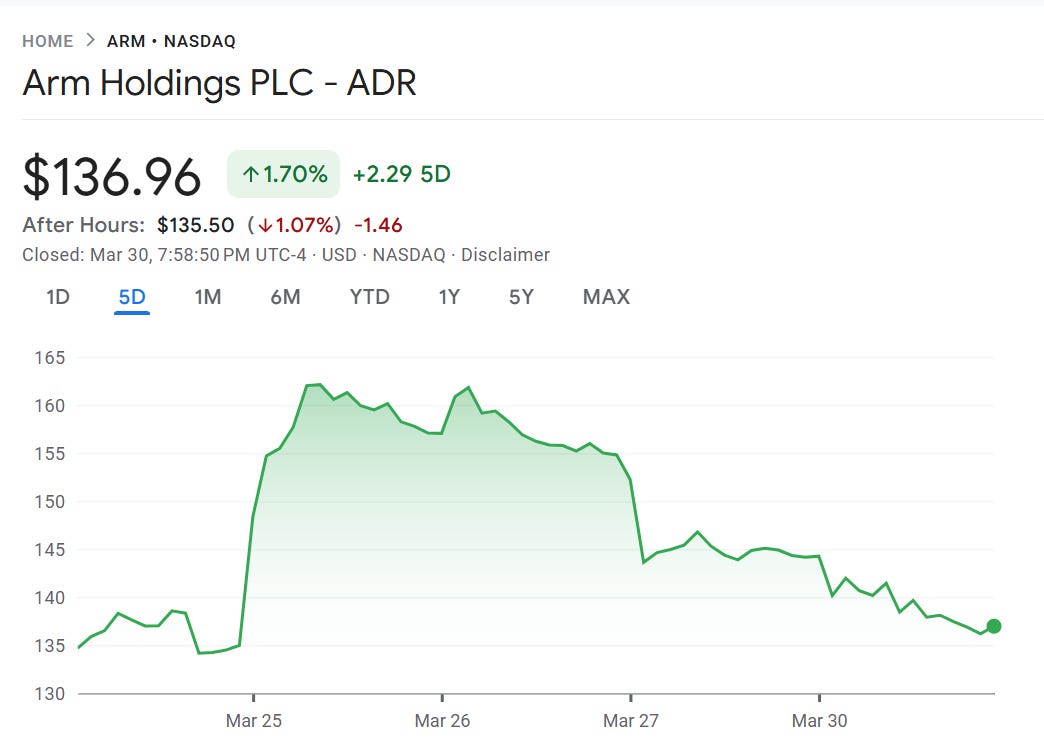
Arm clearly sees this as a big deal, as did investors, giving Arm’s stock price a substantial bump (although, possibly for other reasons, those gains have since been given up.
And the key reason for this initial excitement: Arm projects revenue of up to $15 billion from its AGI CPU business by 2031.
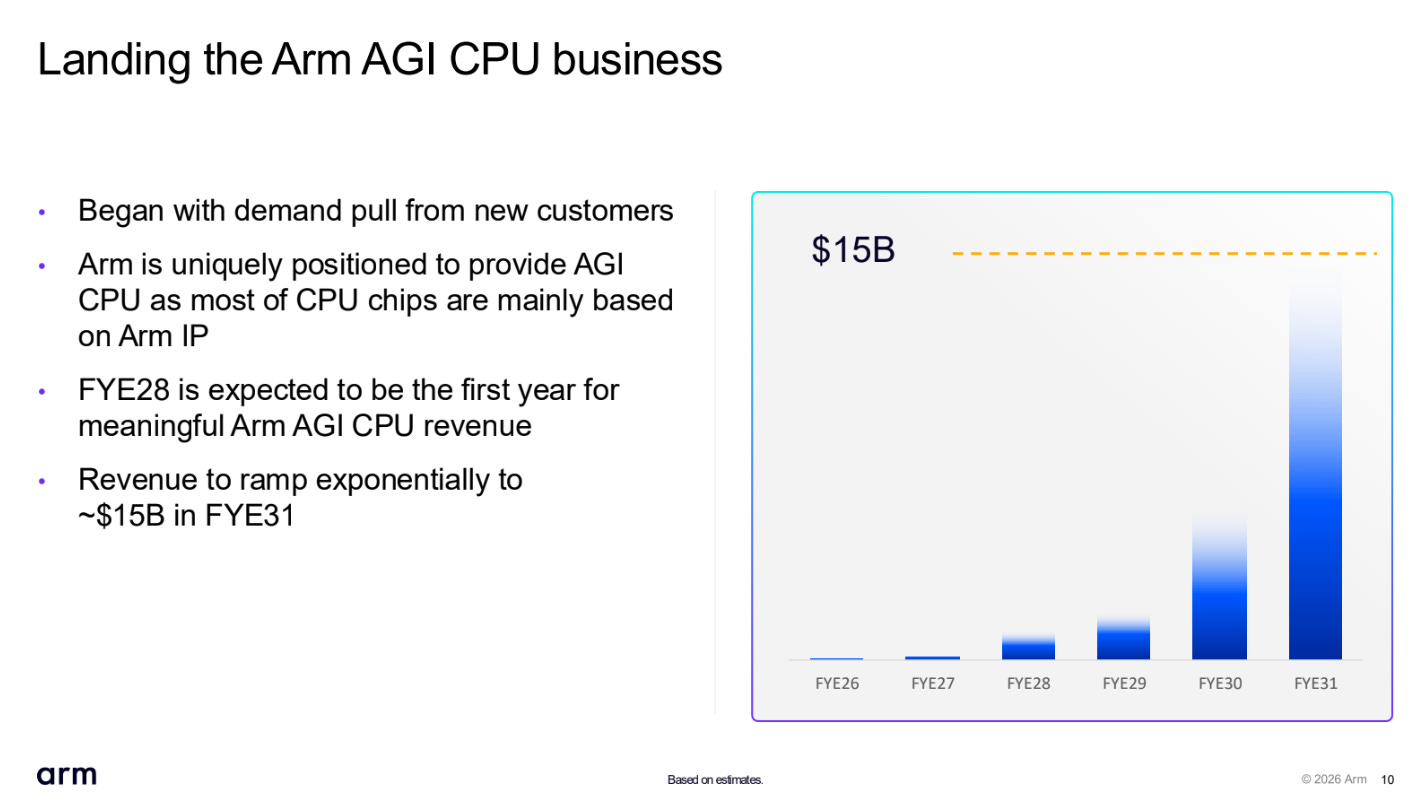
Whether those projections are realistic, and will be fulfilled, is debateable, but still there is a huge opportunity here. For context I estimate that Arm’s total revenue over the 35 years since it was founded amounts to just $40 billion.
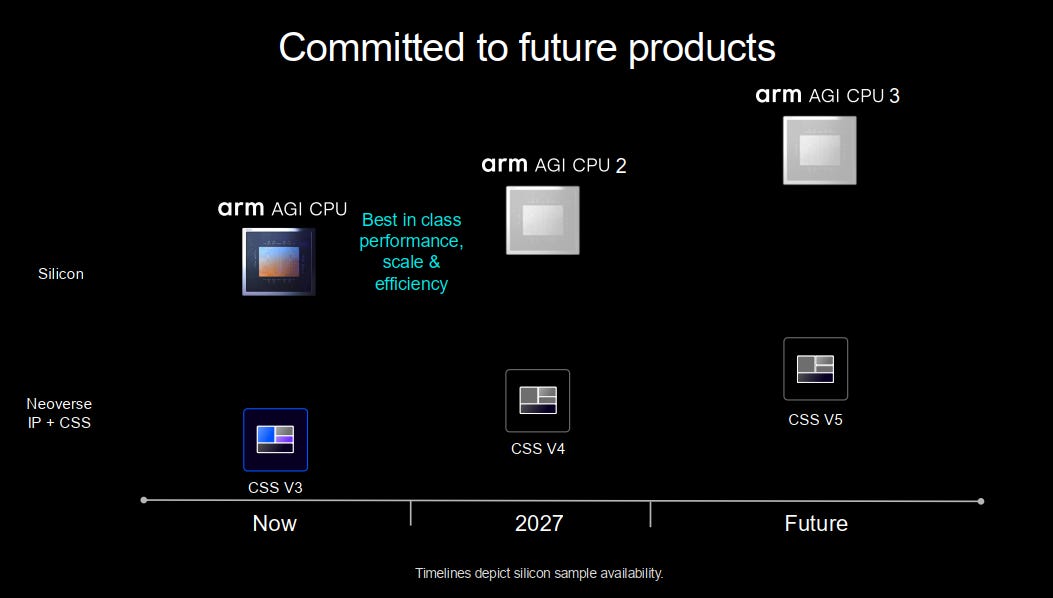
And the first Arm AGI CPU is just the first of a series of Arm CPUs, with AGI CPU 2 following next year and AGI CPU 3 after that.
Cue lots of wailing and gnashing of teeth from some quarters.
Let me say up-front that the name of this CPU is really bad: everyone will, of course, think of ‘Artificial General Intelligence’ and this quote to The Register doesn’t help:
“We think that the CPU is going to be fundamental to ultimately achieving AGI,” Mohamed Awad, Arm’s EVP of cloud AI, told El Reg.
The CPU maybe, but not this specific CPU. You might say that Arm, doesn’t know it’s AGI from its elbow. The naming definitely isn’t securities fraud though.
There is a more fundamental criticism of the Arm AGI CPU though that goes back to Saxby’s original strategy. Isn’t Arm now competing with its customers, with the ecosystem that it’s spent decades painstakingly cultivating? How could anyone using Arm’s CPU designs or an Arm ISA now trust Arm? Won’t this accelerate the switch from Arm to RISC-V?
Given these questions, why would Arm depart from its decades-long approach?
The answer, in this increasingly complex, and AI inflected world, is complicated. In part at least though, the rationale has its roots in another part of Arm’s long-standing business model.
In the rest of this post we’ll look at Arm AGI and try to understand why Arm has chosen to overturn decades of discipline and give in to the temptation to make its own chips.
Arm AGI CPU
First though, what is the Arm AGI CPU?
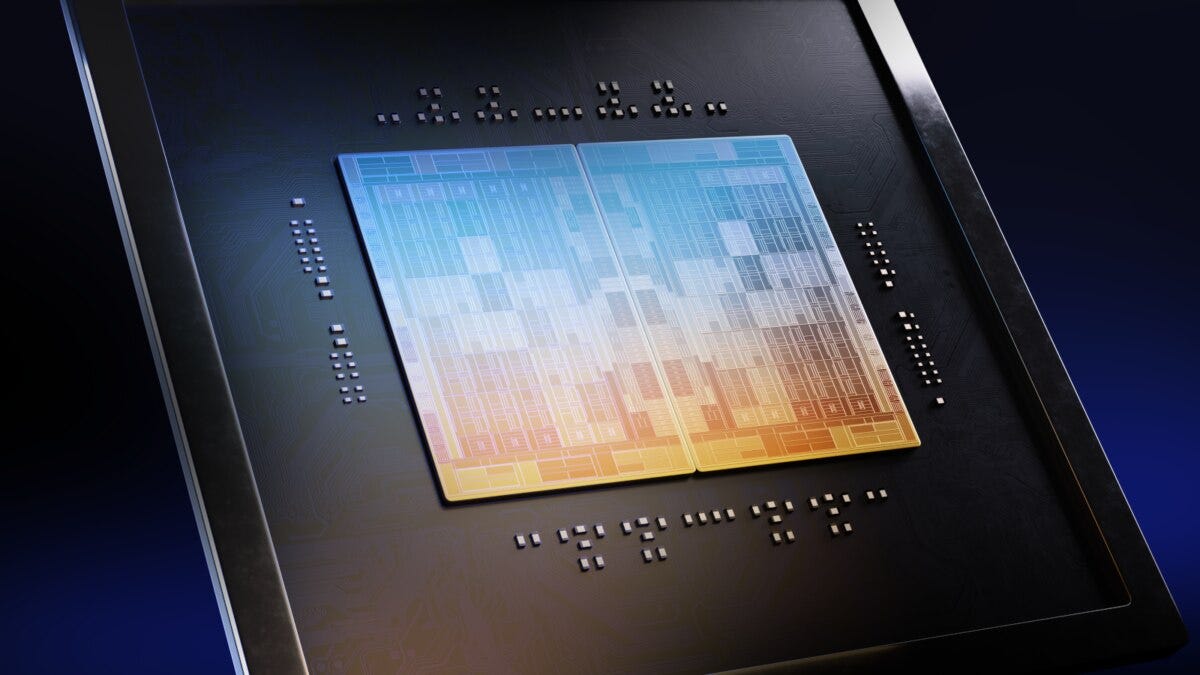
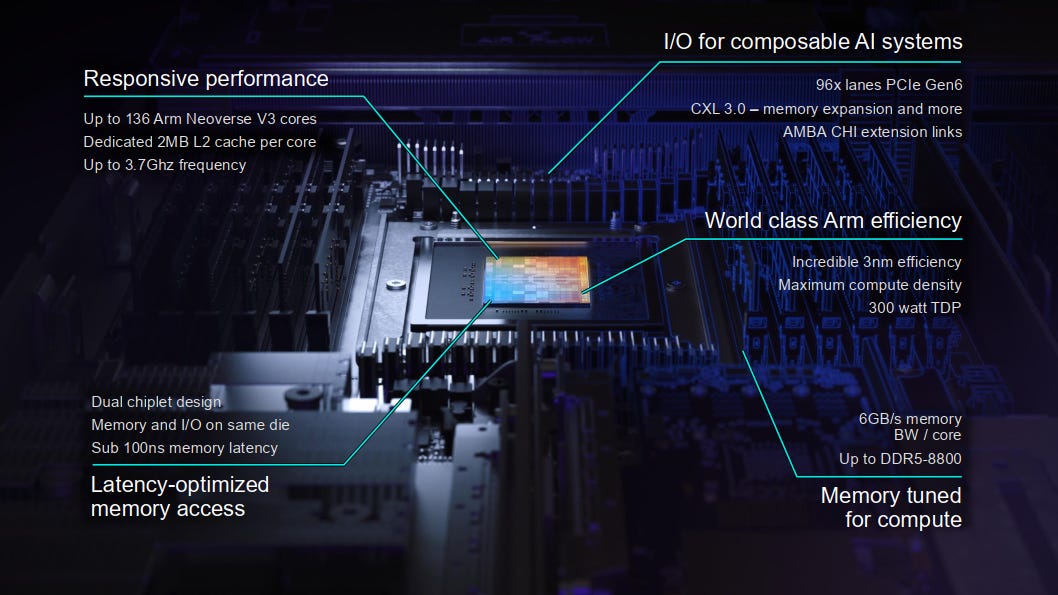
Its a server CPU based on Arm’s Neoverse V3 server core, with up to 136 of these cores on dual chiplets.
Arm made a lot of Arm AGI’s suitability for ‘Agentic’ AI workloads:
AI systems are increasingly operating continuously at global scale. Historically, the human was the bottleneck in computing – the pace at which people could interact with systems defined how quickly work could move through them. In the era of agentic AI, that constraint disappears as software agents coordinate tasks, interact with multiple models and make decisions in real time.
As AI systems run continuously and workloads grow in complexity, the CPU becomes the pacing element of modern infrastructure – responsible for keeping distributed AI systems operating efficiently at scale. In a modern-day AI data center, the CPU manages thousands of distributed tasks – orchestrating accelerators, managing memory and storage, scheduling workloads and moving data across systems – and now, with agentic AI, coordinating fan-out across large numbers of agents.
…
Agentic AI workloads demand sustained performance at massive scale. The Arm AGI CPU is designed to deliver high per-task performance at sustained load across thousands of cores in parallel – all within the power and cooling limits of modern data centers.
Every element of the Arm AGI CPU – from operating frequency to memory and I/O architecture – has been designed to support massively parallel, high-performance agentic workloads in a densely populated rack deployment.
And of course most server cores being shipped today are still x86 based. Haas made a lot of the efficiency of Arm versus x86.
You see, Arm AGI CPU has been designed from the ground up to make sure that performance scales and power stays predictable.
That’s the super power, performance, scale and efficiency. And it’s resonating with our partners.
You see, that’s a very different approach than taken by x86.
They are burdened with execution overhead and legacy feature support.
They chose to focus on things like modularity, support for lots of different markets, and esoteric use cases.
We are ruthlessly focused on improving efficiency and reducing latency. Ultimately, this is about architectural philosophy.
We’re not strapped to the past. We are not strapped to the past. Listen, we don’t support Lotus Notes, okay? We just don’t do it. We’re focused on exactly and only what the data center needs.
I like a good RISC vs CISC debate as much as anyone but Lotus Notes? That’s harsh!
Arm’s press release pressed home Arm’s claimed advantages over x86:
Arm AGI CPU’s class-leading memory bandwidth means more effective threads of execution per rack; x86 CPUs degrade as cores contend under sustained load.
High performance, efficient, single-threaded Arm Neoverse V3 CPU cores outperform legacy architectures; every Arm thread does more work.
More usable threads and more work-per-thread compounds to massive performance gains per rack.
I’m not going to analyse the validity of these claims for real-world CPUs: the fact that the Arm architecture has an advantage isn’t generally disputed although the extent and importance of that advantage usually is subject to competing claims.
Arm AGI will be competing with Intel and AMD but also with other Arm server cores. Which takes us back to our original question: why would Arm now choose to break with decades of discipline and compete with its customers?
Keep reading with a 7-day free trial
Subscribe to The Chip Letter to keep reading this post and get 7 days of free access to the full post archives.