
Arm, the UK and Apple
The Softbank takeover and ISA transitions

The latest episode of Supply Chained, the new podcast from Tim Culpan and Jon Y has just dropped and it’s all about Arm. Before we go any further please drop what you’re doing and subscribe to Supply Chained and to Tim and Jon’s newsletters; you can thank me later.
The podcast episode is titled ‘Arm might be swallowing its own poison pill’ and most of the discussion is about Arm’s decision to launch its own CPU.
We’ve covered this move in detail recently in Arm Makes Chips!

Tim and Jon bring an interesting perspective to the move: that Arm’s refusal to make (or rather sell) chips made it immune from takeover by a big chip seller such as Intel, Nvidia or Qualcomm. Indeed this ‘poison pill’ meant that Nvidia’s bid to buy Arm from Softbank was ended by competition authorities in 2022. So by becoming a chip seller now Arm is effectively swallowing its own poison pill!
Tim and Jon’s discussion then moves on to the purchase of Arm by Softbank in 2016 and wondering why the UK government allowed the sale of, arguably, the UK’s leading technology company. Understandably Jon and Tim are baffled!
As readers will know from the flavour of the spelling in this newsletter Babbage (me) is based in the UK and so had a ringside seat to the full political context of the Arm sale. I’ve also just finished reading Gambling Man, the 2022 biography of Softbank founder Masatoshi Son - widely known as Masa - by former Financial Times editor Lionel Barber, which has a whole chapter on the sale of Arm.
In the rest of this post we’ll try to understand why this sale took place and whether it really was bad news for the UK.
We’ll end by considering an interesting idea put forward by Tim at the end of the podcast: that Apple should ditch the Arm ISA in favour of its own CPU ISA.
Why did the UK sell Arm to Softbank?
Some brief background on the sale. Arm had been listed on the London Stock Exchange (and on Nasdaq) ever since its flotation in 1998. The sale of the firm to Softbank was announced on 18 July 2016 as the BBC reported:
UK technology firm ARM Holdings is to be bought by Japan’s Softbank for £24bn ($32bn) it confirmed on Monday.
The board of ARM is expected to recommend shareholders accept the offer - which is around a 43% premium on its closing market value of £16.8bn on Friday.
On the face of it, this was a great result for Arm’s shareholders who saw a very substantial uplift in the value of their shareholdings.
However, not everyone was happy including Hermann Hauser, the man who oversaw the development of the first Arm CPUs as co-founder of Acorn Computers:
… Hermann Hauser said: “This is a sad day for me and a sad day for technology in Britain.”
“ARM is the last British [technology] company that has a global reach,” he said.
“It gave Britain real strength. It was a British company that determined the next generation microprocessor architecture.”
I’m sure that Hauser and others would have been on their (Arm powered) smartphones calling ministers in the UK government to try to stop the takeover.
A premium of 43% over the previous share price didn’t really give Arm’s Board of Directors much room to refuse a cash bid like Softbank’s but what about the UK government? Why did they allow this takeover to proceed?
There is one clue in the date of the takeover bid: July 2016. Just a few weeks earlier on 23 June 2016 the UK had (narrowly) voted to leave the European Union (an act universally known as Brexit). Prime Minister David Cameron had resigned and was quickly replaced by Teresa May.
No-one really knew what would happen next. It would take another three and a half years before the UK would actually leave the EU but there was, to say the least, a lot of uncertainty especially for UK businesses. One particular concern whether non-UK businesses would continue to invest in the UK post Brexit.
Unsurprisingly, the new government chose to ‘spin’ the takeover as providing reassurance on this issue:
Prime Minister Theresa May said the deal between Softbank and ARM Holdings showed the UK economy could be successful after the country voted to leave the European Union.
A spokeswoman for the prime minister said Mrs May believed the deal was in the country’s national interest - a gauge that she will use to assess any future foreign takeovers.
“This is good news for British workers, it’s good news for the British economy, it shows that, as the prime minister has been saying, we can make a success of leaving the EU,” the spokeswoman added.
There was also a major problem with any attempt to block the takeover. One of the attractions of the UK’s business environment was (and is) its (comparatively) stable legal framework. In particular, the UK government is bound by the laws passed by parliament.
And those laws only allow intervention in situations like this in some clearly defined circumstances: where there is a competition or national security issue.
Former Business Secretary [and opposition party member] Vince Cable told the BBC there was usually very little the government could do to prevent takeovers.
“We don’t have a system of defence against takeovers if they prove to be unsatisfactory,” he said.
Mr Cable added the government had few legal powers to stop takeovers unless it could be demonstrated there was a national security issue.
There was no rationale to block this takeover on competition grounds - note that the UK’s new competition regulator the CMA would later take action to block the Nvidia deal to buy Arm in 2020 when there were real competition concerns - and a ‘national security’ objection would be likely to have been challenged and been defeated in the UK’s courts.
Arguably the UK government could have tried to pass new laws specifically to protect Arm from takeover but in the extreme uncertainty after the Brexit vote its unlikely that the government had the bandwidth or the support from its own - largely free market thinking - members of parliament. Had it tried there would likely to have been howls of protest from Arm’s shareholders upset at losing their 43% share price premium. There is also the question as to whether these laws would have been compatible with EU rules: remember that the UK was still a member of the EU at this point.
But there was also lots going on behind the scenes, as Barber’s book Gambling Man reveals. Masa had employed former Morgan Stanley banker Simon Robey who was able to arrange a meeting with the UK’s top civil servant, Jeremy Heywood. Heywood, Barber says, wanted to ‘look Masa in the eye’.
The meeting took place against the backdrop of the political fallout from Brexit:
On Wednesday, 13 July, just before noon, as David Cameron was facing parliamentary questions on his last day as prime minister in the House of Commons, Masa entered the lacquered black door at 10 Downing Street. A study in Japanese humility, he told Heywood he wanted to build a long-term relationship with the UK government based on trust. He’d long admired ARM as a world-class technology company but would only proceed with his bid with the government’s full support.
Heywood tested SoftBank’s plans for future investment in the ARM business. What kind of sums were on the table? Over what time frame? Mindful of Brexit’s economic impact, he also pressed for undertakings to boost the workforce. Above all, he wanted SoftBank to commit to ARM’s headquarters in Cambridge.
Masa responded with a confident smile. More investment? Not a problem!. More jobs? Naturally! In fact, he would double the workforce. (ARM executives had initially proposed an 80 per cent increase, but Masa said doubling the number of jobs sounded far better.) When Heywood pressed for guarantees that Cambridge would remain as ARM HQ, Masa pledged that Cambridge’s position was secure. ARM, he promised, would be at the centre of SoftBank’s ‘ecosystem’.
The fact that Softbank was a Japanese company helped Masa make his case:
‘If SoftBank had been an aggressive American company or a French buyer, there might have been a more negative reaction,’ says one SoftBank adviser, ‘but a Japanese company was different. There was no way shareholders or the government could turn it down.’
The meeting with Heywood was soon followed by an ‘awkward’ meeting with the famously awkward Prime Minister Theresa May:
The meeting with Britain’s new prime minister was more awkward. Masa had called May after she’d been elected Tory party leader on 13 July, saying he had a ‘big gift’ for her, a major investment in the UK when other business bosses were fleeing the country because of Brexit. Now he insisted on a meeting in Downing Street, seeing this as a chance to ‘build trust’. The meeting took place on Monday, 25 July.
Notoriously shy, May was prone to long awkward silences. Seeking to break the ice, [Arm Chair Stuart] Chambers, accompanying Masa, praised the government’s new industrial strategy: ‘I know what you are trying to do.’ May assumed he was referring to Labour-style intervention in the economy, and put on her Medusa face. The meeting ended soon afterwards.
Despite the awkwardness, Masa’s assurances were accepted by the government, May’s government decided not to contest the takeover and it went through.
A Major Blow to UK Technology?
In common with Hermann Hauser and many UK commentators I was sad to see Arm become owned outside the UK. I was one of the first people to hear about the very first Advanced RISC Machines processor before it even appeared in a real product. It’s important though in these situations to separate emotion from the real impact of a change like this. We need to answer the question as to what extent this change of ownership actually matters. The answer, I think is that it does, but less than some commentators have implied and not in the ways that one might immediately expect.
First of all was Arm really UK owned? Yes, it was listed on the London Stock Exchange but in the absence of access to the shareholder register from 2016, I would expect that a large proportion (maybe even the majority) of Arm stock would have been held outside the UK. Had Arm continued as a UK listed company then I’m sure that the non-UK proportion would only have increased.
Still many UK investors have certainly have missed out on the spectacular gains made by Softbank when Arm was re-listed in the NASDAQ in 2023 for and from the recent gains from the ‘Agentic CPU’ boom giving Arm a market cap of more than $220bn.
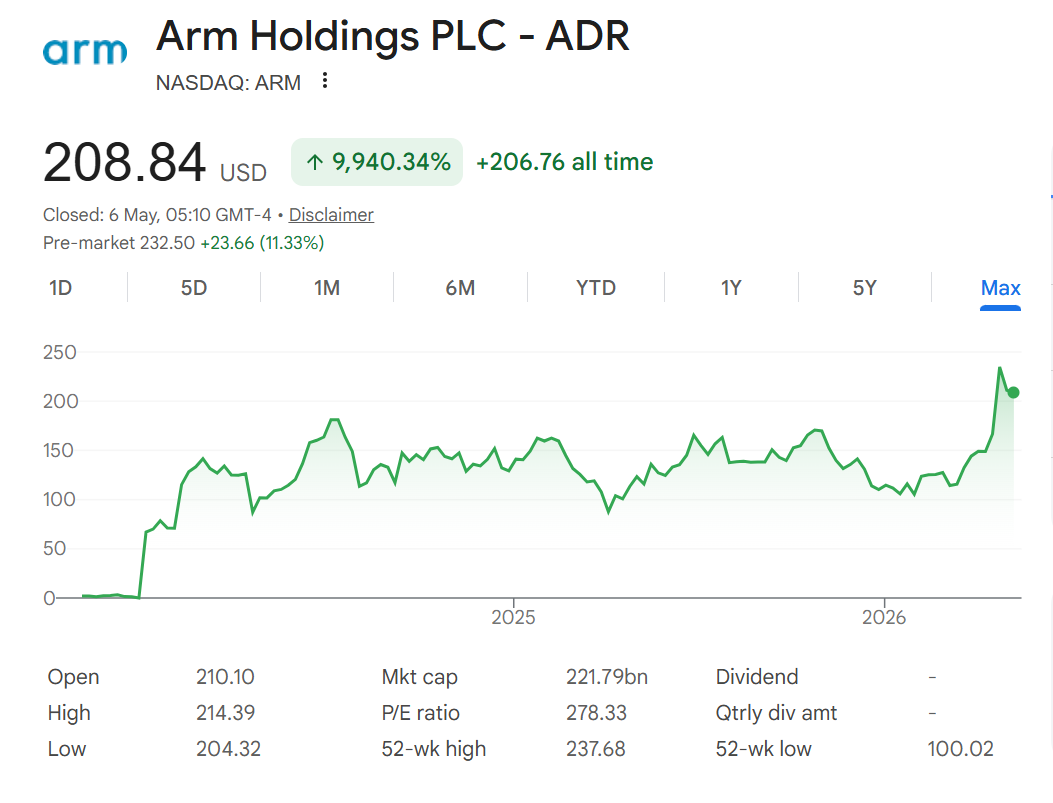
I don’t think this is why most commentators think that the sale of Arm was problematic though. Rather they see it as weakening the UK (and Europe’s) technology base. Here I think the picture is even less clear.
Investing in Arm
As we’ve seen Softbank committed to massively increase investment in Arm’s operations in the UK. That investment is part of the reason why Arm is now valued so highly.
It’s very unlikely that investment at the level that Softbank owned Arm has undertaken over the last ten years would have happened had it remained as a UK listed company. It’s shareholders would not have tolerated the level of losses that this would have implied. Gambling Man recounts Arm’s former CEO Simon Segar’s reaction to an Arm investor’s unhappiness at the firm’s - then quite limited - investment plans:
Shortly before SoftBank’s approach, a London fund manager asked Segars why ARM’s margins were slightly down. The company was investing, he replied. The fund manager was unconvinced. ‘When does the investing phase end and the harvesting begin?’.
Segars quietly cursed. ‘In the world of tech, the moment you stop investing you are on the verge of death. There is always something new to invest in.’
As we’ve seen Masa committed to invest in Arm in the UK; including to double Arm’s UK headcount. Was this pledge met? In short, yes it was.
The original “Rule 2.7” announcement filed with the London Stock Exchange (July 18, 2016) stated:
“SoftBank has provided assurances to at least double the employee headcount in the UK... over the next five years.”
Because the pledge was legally binding under the UK Takeover Code, Arm and SoftBank had to file annual compliance reports. In 2021, the UK Takeover Panel confirmed that SoftBank had fulfilled its post-offer undertakings. Specifically, UK headcount doubled from around 1,700 in 2016 to mire than 3,500 in 2021.
Arm isn’t TSMC
Notwithstanding the additional UK investment, it seems that Arm’s centre of gravity has shifted away from the UK. Looking at the Board of Directors in 2026 none seem to be based in the UK and all apart from Son seem to be based in the US.
Development of the new Arm AGI CPU, shared in this video, took place in Texas.
But this is just the continuation of a trend. Arm has, by necessity, always been an international company. The creation of a design centre in Texas in the late 1990s was one of the key steps in the firm’s development. Previous CEO Simon Segars was based in Silicon Valley for a large part of his time with the company.
Even as a UK listed company the firm had a duty to do the best for it’s shareholders and that means going to its customers and seeking out the best talent wherever it can find it. In chip design that means heading to Silicon Valley and Texas! It’s not great news but better to have a globally successful company with a major base in Cambridge than a failed one that has no operations outside the UK!
Today slightly under a half of Arm’s employees are based in the UK, roughly the same proportion as at the time of the Softbank takeover.
And the contrast with TSMC is relevant here. Unlike the Taiwanese giant Arm’s business doesn’t naturally lead to a large ecosystem of suppliers and associated companies. Arm isn’t building huge fabs on a regular basis.
Whilst we are discussing TSMC what about the politics of control? In the era of Chip Wars and Trump hasn’t the UK lost a key bargaining chip? The UK doesn’t have a neighbour that claims its territory so doesn’t need a ‘silicon shield’. In any event its debatable whether the Arm ISA and Arm designs could be used for any geopolitical purpose. The company could theoretically stop supplying new CPU designs to hostile states but that’s not any way as near as effective as cutting off the supply of finished semiconductors.
So do I think that the Arm takeover was a neutral or even good thing for the UK? No, but it’s not as bad as some have portrayed it.
Apple and Arm
We’ll end with Tim’s suggestion that Apple should ditch the Arm ISA and instead develop and use its own. The rationale being that Apple likes to have control of its own technologies and that control of the application processor CPU used in Apple Silicon’ would give Apple the opportunity to tailor the ISA to its own requirements.
Readers will know that Apple and Arm have a long history: Apple was an original investor in ARM Limited alongside Acorn Computers and VLSI Technology all the way back in 1991. Devices running the Arm ISA have been crucial components in almost all Apple portable devices from the Newton through the iPod and the original iPhone. Today every Apple device with a CPU from AirPods to the Mac Studio runs Arm code.
Arguably Arm saved Apple as the sale of it’s shareholding in the newly floated Arm was a key source of cash for the Cupertino company in its darkest days in the late 1990s.
Apple isn’t a sentimental company though, and I’m sure that it’s shared history plays zero part in any ongoing decision to use or abandon Arm.
Could Apple Move?
So could Apple move on from the Arm ISA?
Keep reading with a 7-day free trial
Subscribe to The Chip Letter to keep reading this post and get 7 days of free access to the full post archives.